
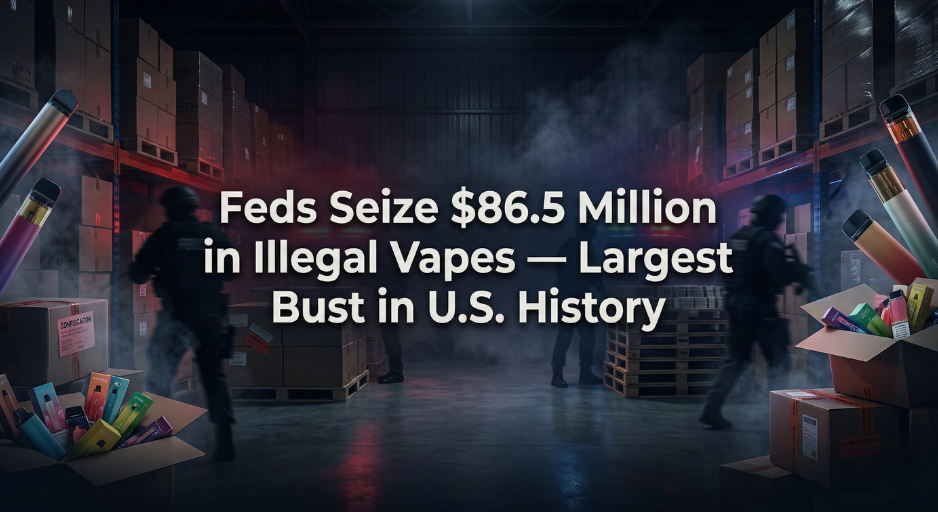
What Happened: A Record-Breaking Federal Raid
In September 2025, U.S. federal agencies executed the largest illegal vape seizure in American history — a joint operation that netted 4.7 million unauthorized e-cigarette units with an estimated retail value of $86.5 million. The action was carried out by the U.S. Department of Health and Human Services (HHS) through the FDA, in partnership with U.S. Customs and Border Protection (CBP), the Department of Justice, and the Drug Enforcement Administration across six states simultaneously.
Attorney General Pam Bondi, HHS Secretary Robert F. Kennedy Jr., and FDA Commissioner Dr. Marty Makary held a joint press conference at the Illinois seizure site in Bensenville — a suburb of Chicago — to announce the results. The scale of the operation and the seniority of officials involved signaled a clear shift in how seriously the federal government is now treating the illegal vape trade.
Who Was Involved and Where It Happened
The operation targeted incoming import shipments at U.S. ports of entry, as well as domestic distribution warehouses. Among the businesses raided was Midwest Goods, one of Illinois' largest e-cigarette distributors, based in Bensenville. Federal agents executed search warrants at multiple locations across the six states.
FDA and CBP investigators had conducted months of planning prior to the raids, identifying suspect shipments through intelligence work. Agents found that many of the intercepted shipments carried misleading product descriptions and understated values — tactics used to evade customs duties and import safety screening.
| Agency | Role in Operation |
|---|---|
| FDA (HHS) | Lead agency; identified non-compliant shipments, executed product seizures |
| CBP | Border inspection and interception of incoming shipments |
| DOJ / AG Bondi | Coordinated criminal enforcement, search warrants, prosecution |
| DEA | Investigated vape shops near schools and military installations |
What Was Seized — and Why It Was Illegal
Every product seized in the operation lacked FDA premarket authorization — meaning none had gone through the Premarket Tobacco Application (PMTA) process required by federal law before a vaping product can be legally marketed or sold in the United States. The FDA has authorized 41 e-cigarette products in total as of March 2026. The 4.7 million units confiscated in this single operation represent products that exist entirely outside that legal framework.
Beyond the authorization issue, federal investigators flagged serious safety concerns. Many of the seized disposable vapes reportedly contained carcinogens, toxic additives, elevated heavy metal levels including lead, and other unidentified substances. Products were also found to use candy flavors, toy-like designs, and fashion accessory packaging — all characteristics regulators associate with intentional marketing to minors.
The FDA also contacted 37 importers and entry filers involved in bringing the products into the country, warning them that making false statements to the U.S. government is a federal crime.
Part of a Much Larger Federal Campaign
The $86.5 million raid did not happen in isolation. It was the single largest action in an ongoing and escalating federal enforcement campaign. By the time the Bensenville press conference was held, the FDA and CBP had already stopped more than 6 million unauthorized e-cigarettes worth over $120 million from entering the country in that same calendar year — and that total continued to climb.
The operation built directly on an earlier joint FDA and CBP sweep that seized nearly $34 million in illegal e-cigarettes, and a separate DOJ nationwide action that confiscated more than two million illicit vaping products. The DEA simultaneously ran Operation Vape Trail, targeting vape shops operating in proximity to schools and military bases.
At the federal budget level, the U.S. Senate Appropriations Committee has directed the FDA to dedicate $200 million in FY 2026 specifically for illegal vape enforcement — funding that is expected to dramatically expand the scale and frequency of operations like this one going forward.
The Cartel Connection: Beyond a Regulatory Problem
What began as a public health and youth safety issue has taken on a national security dimension. Congressional letters to the U.S. Trade Representative, dated March 2026, cited Associated Press reporting indicating that Mexican drug cartels have secured a dominant share of the illegal vape market in Mexico and are actively expanding operations inside the United States.
The Bureau of Alcohol, Tobacco, Firearms and Explosives has traced funds from illicit Chinese e-cigarette sales to foreign adversaries and cartel operations. The DOJ has reported that unauthorized vapes are being smuggled from China and sold near schools and military installations, putting both minors and service members at risk. Federal lawmakers have formally urged the U.S. Trade Representative to elevate the issue in trade negotiations with China and push for a binding commitment to halt the export of non-compliant products.
What This Means for Buyers in 2026
The supply of unauthorized vapes is shrinking — deliberately. The federal government is no longer issuing warning letters and moving on. It is executing multi-agency, multi-state raids and destroying product at the border before it reaches retail. For consumers who have relied on unauthorized brands, that supply chain is becoming significantly less reliable and more legally risky.
Unknowing buyers are not immune. State registry laws in Indiana, Pennsylvania, Mississippi, California, Texas, and elsewhere make it a civil or criminal infraction to possess products not on the approved directory — regardless of where you bought them. Purchasing an unauthorized product online does not guarantee you won't face consequences if your state has a strict registry law in place.
Compliant retailers are the safest option. Online vape retailers operating in compliance with state shipping laws and carrying authorized or state-directory-listed products offer the clearest legal path for adult consumers. As enforcement pressure increases at the border and in distribution warehouses, product from unauthorized supply chains will become harder to find and riskier to buy.
The FDA flavor authorization landscape is shifting. In March 2026, the Washington Post reported that the FDA is signaling it may expand its authorization to allow a broader range of flavors beyond tobacco and menthol. If that shift materializes, it will open a new legal pathway for the flavored disposable vapes that dominate consumer demand — reducing the gap between what buyers want and what is legally available.
JellyPuffs carries a curated selection of disposable vapes for adult consumers, including compliant and USA-made options. Shop our full lineup — and always verify your state's vaping laws before purchasing.
Sources
- HHS.gov — "HHS, CBP Seize $86.5 Million Worth of Illegal E-Cigarettes in Largest-Ever Operation" (Sept. 10, 2025)
- FDA.gov — "HHS, CBP Seize $86.5 Million Worth of Illegal E-Cigarettes in Largest-Ever Operation"
- CBP.gov — "CBP, HHS Seize $86.5 Million Worth of Illegal E-Cigarettes in Largest-Ever Operation"
- CSP Daily News — "Federal Agencies Seize $86.5M Worth of Illegal E-Cigarettes" (Jan. 21, 2026)
- U.S. House — Congressional Letter to USTR on Chinese Vape Exports (Mar. 4, 2026)
- FDA CTP Newsroom — Enforcement Actions and Announcements (2025–2026)
- Washington Post — "The FDA's Flavored Vape Ban Was a Shortsighted Disaster" (Mar. 17, 2026)


