
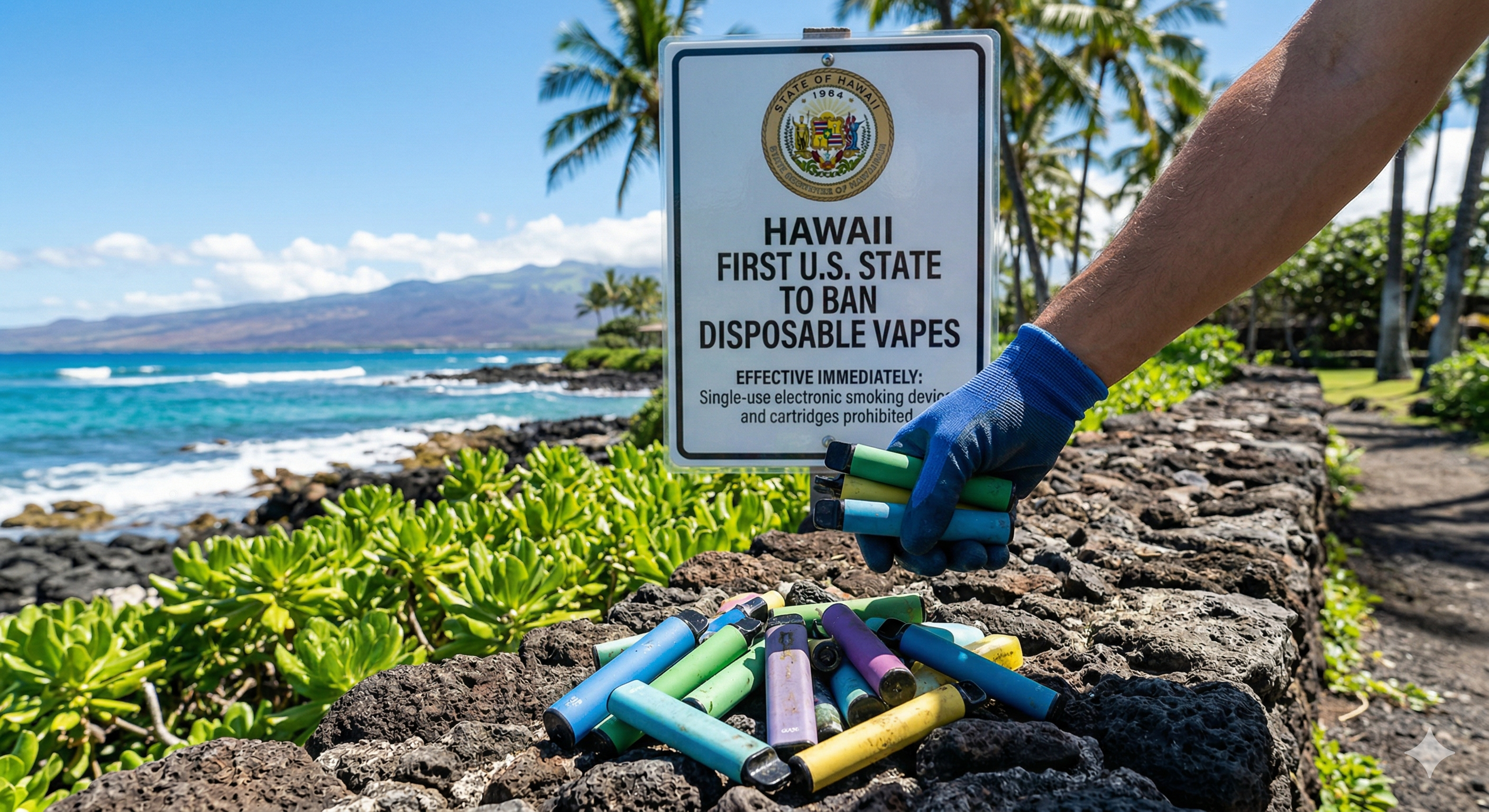
Hawaii Moves to Become the First U.S. State to Ban Disposable Vapes
Governor Josh Green and the state attorney general stood alongside student protesters this week urging passage of bills that would make the sale of all disposable vapes illegal in Hawaii by 2027.

Photo: Unsplash — Disposable vape use has surged among U.S. teens and young adults over the past five years.
Hawaii is on the verge of becoming the first state in the nation to ban the sale of all disposable vape devices outright. On March 19, Governor Josh Green and Attorney General Anne Lopez joined scores of student advocates at the State Capitol in Honolulu, publicly endorsing legislation that would prohibit the sale of single-use vaping products beginning in 2027.
The move marks a significant escalation in the nationwide effort to curtail the disposable vape market — a category that now accounts for more than 60% of all U.S. e-cigarette sales — and sets Hawaii apart from every other state that has opted for flavor bans or product-registry systems rather than an outright prohibition on the devices themselves.
The Capitol Rally
The rally was organized by the Coalition for a Tobacco-Free Hawai'i Youth Council, a youth advocacy arm of the Hawai'i Public Health Institute. Students from high schools across the state gathered on the Capitol steps, waving signs alongside the governor — a physician by training — and the state's top law enforcement official.
The show of executive support is notable. Governors and attorneys general rarely appear at legislative rallies mid-session, signaling that the administration views this as a priority bill rather than a routine policy debate.
What the Bills Actually Say
Two companion bills are advancing through the Legislature simultaneously: House Bill 2121 and Senate Bill 2175. Both are functionally identical in their core provision — starting January 1, 2027, the sale of any "disposable electronic smoking device" in Hawaii would be illegal. The prohibition targets devices that cannot be refilled or that carry a non-rechargeable battery, which covers the vast majority of products on the market today.
A third bill, House Bill 1573, adds an annual compliance layer. Under HB1573, vape manufacturers would be required to prove every year that each product line they sell in Hawaii holds an FDA marketing granted order. Manufacturers unable to demonstrate compliance would be de-listed from a state-maintained registry of approved products. Fines would run up to $10,000 per violation for manufacturers and $500–$2,000 per product for distributors caught selling de-listed items.
Attorney General Lopez noted that HB1573 effectively gives the state an enforcement mechanism it has long lacked — the legal authority to pull unlisted products off retail shelves rather than relying on federal action.
The Youth Vaping Crisis Driving the Push
Lawmakers cite teen addiction as the primary justification. State Sen. Tim Richards, a co-introducer of SB2175, told the rally that more than one-third of Hawaii high schoolers have tried vapes and that users are four times more likely to take up combustible cigarette smoking. Rep. Jeanne Kapela, co-introducer of HB2121, described vape manufacturers as "companies selling addiction disguised as candy," pointing to the fruit and dessert flavors that dominate the disposable category.
Students backed up those claims with on-the-ground accounts.
"It's gotten to the point where it's a gamble whether the bathroom is closed because of all the kids vaping. Sometimes the teachers don't even bother trying to confiscate the vapes anymore." — Jeremiah Jacinto, senior, H.P. Baldwin High School
Jacinto estimated he could name roughly 50 classmates with vaping dependencies, describing the devices as functionally inseparable from daily student life. Environmental concerns also featured prominently. Disposable vapes contribute an estimated 142 million units of e-waste annually in the U.S., according to figures cited in committee testimony, with lithium-ion batteries posing fire risks in recycling facilities.
Industry Pushback
Not everyone at the Capitol backed the legislation. Michael Zehner, co-chair of the Hawai'i Smokers Alliance — a consumer advocacy group that opposes smoking and vaping bans — testified against HB2121, calling it a "mean spirited, anti-business mess of a bill" that would devastate local vape retailers who have built businesses around the disposable category.
The objection reflects a broader tension that has played out in every state that has moved against disposable vapes: independent retailers and adult consumers who use the products as a less harmful alternative to cigarettes bear the cost of regulations aimed at protecting minors. Hawaii's bills contain no carve-out for adult-use harm reduction.
Where This Fits in the National Picture
If passed, Hawaii would be the first U.S. state to implement a full ban on the sale of disposable vapes — a distinction that Nate Hix, policy director at the Hawai'i Public Health Institute, explicitly acknowledged when speaking to reporters. The United Kingdom implemented a comparable ban in 2024.
Nationally, the regulatory picture is a patchwork. At least 12 states have enacted heavy restrictions through three distinct models: flavor bans (California, Massachusetts, New Jersey, New York, Rhode Island), product-directory systems that restrict sales to state-approved lists (Wisconsin, North Carolina, Florida), and origin bans targeting Chinese-manufactured devices (Texas, Indiana). The FY 2026 federal appropriations bill also directed $200 million toward FDA enforcement against unauthorized vape imports — a record allocation — and granted border authorities new "seize and destroy" powers over unauthorized shipments.
Hawaii's approach is categorically different from all of these. A device-type ban does not ask what flavors are in a vape, who made it, or whether it has FDA authorization. It bans the hardware form factor itself.
What's Next
As of March 19, the House bills were scheduled for a Senate committee hearing later in the week, while SB2175 had passed its first of two required House committee hearings. Legislative timelines in Hawaii mean a floor vote could come before the session ends in early May.
Should the bills pass and Governor Green sign them — which his public endorsement makes likely — retailers and distributors would have the remainder of 2026 to wind down disposable inventory before the January 1, 2027 effective date. The attorney general's office would be tasked with enforcement, with the state's new registry framework providing the legal backbone for removal actions.
For the vape industry, the stakes extend well beyond one state. A successful Hawaii ban would hand advocates in dozens of other state legislatures a proven legislative model and a precedent-setting argument — that a complete disposable vape ban is legally and politically achievable in the United States.
Sources
- Aloha State Daily · March 19, 2026 Governor and attorney general endorse disposable vape ban
- Hawaii State Legislature HB2121 — Disposable Electronic Smoking Devices (full bill text)
- Hawaii State Legislature SB2175 — Disposable Electronic Smoking Devices (full bill text)
- Hawaii State Legislature HB1573 — Annual FDA Compliance Certification for Vape Manufacturers
- Ecigator · January 27, 2026 Vape Ban 2026: New Federal "Seize & Destroy" Laws Explained
- Tobacco Insider · January 31, 2026 USA: Illegal Vapes — State & Federal Enforcement Tracker
- The Vapers Guide · January 23, 2026 What States Are Banning Vapes in 2026? Complete US Vape Ban Map
- FDA E-Cigarettes Authorized by the FDA (current list)


