
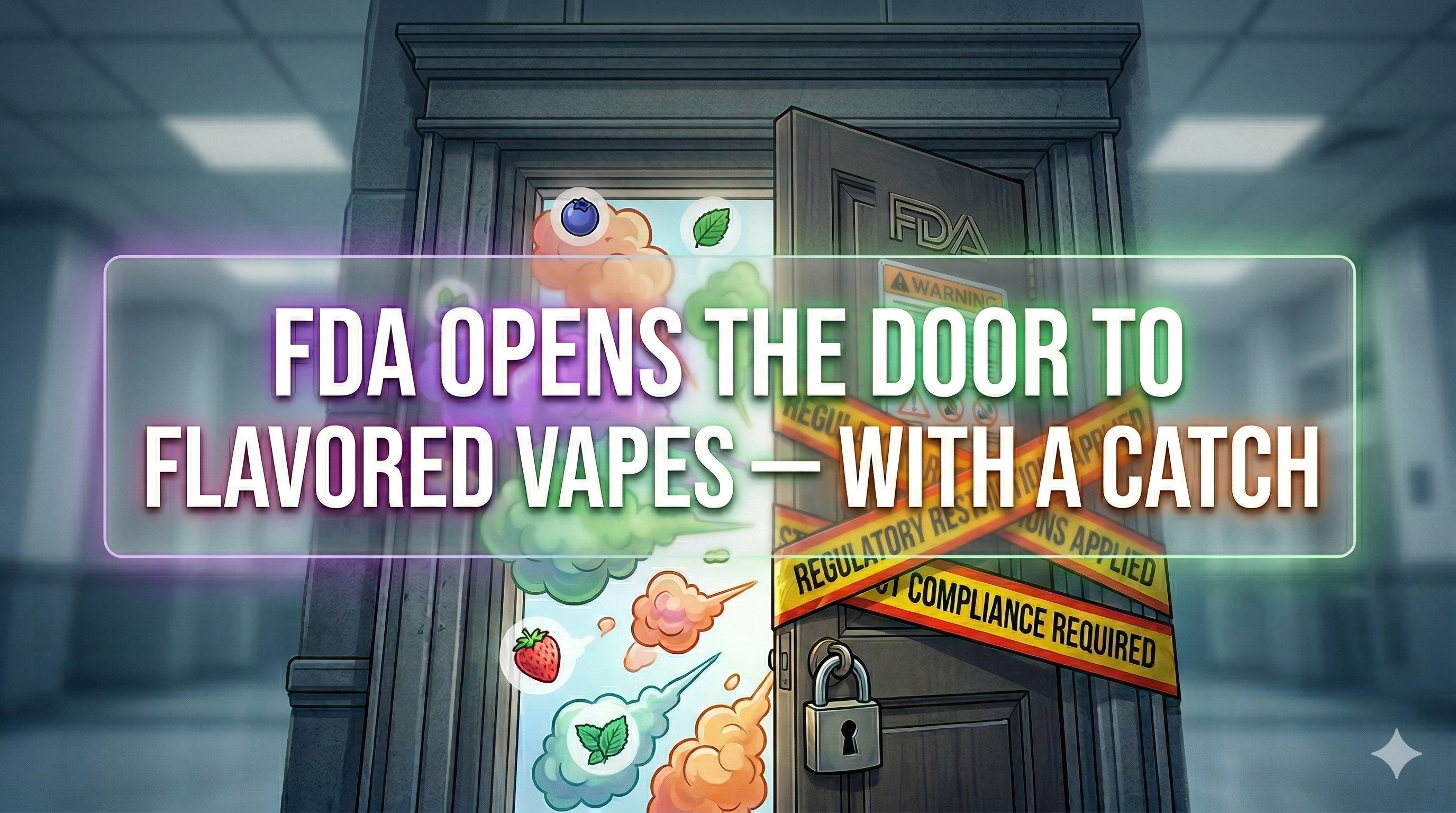
New draft guidance released March 9 signals that mint, coffee, tea, and spice flavors could win federal authorization for the first time — but fruit, candy, and dessert remain off the table.
Contents
What Happened
On March 9, 2026, the FDA's Center for Tobacco Products released a long-awaited draft guidance titled Flavored Electronic Nicotine Delivery Systems (ENDS) Premarket Applications — Considerations Related to Youth Risk. The document is the first formal signal from the agency that it may authorize vape products in flavors beyond tobacco and menthol — a policy position locked in place since the youth vaping crisis of 2019.
The guidance is non-binding and open for a 60-day public comment period. It does not authorize any flavored product outright. But it tells manufacturers, for the first time, exactly what scientific evidence they would need to pursue authorization for flavors like mint, coffee, tea, cinnamon, and similar non-sweet options.
What the Guidance Actually Says
The FDA frames its new framework as risk-based and graduated: the evidentiary bar a manufacturer must clear depends on how appealing their proposed flavor is to youth. Flavors judged to have lower youth appeal — mint, menthol variants, coffee, tea, and certain spices — could potentially achieve authorization with a smaller demonstration of adult benefit compared to a tobacco-flavored baseline.
Fruit, candy, and dessert flavors are a different story. The FDA explicitly labels these a "significant public health risk" and signals they will continue to face an extremely high burden of proof. The agency cited its own data showing that 87.6% of youth who vaped in 2024 used flavored products, with fruit being the most popular category.
The guidance also encourages manufacturers to use sensory perception studies and blinded consumer panel testing — rather than only expensive randomized controlled trials — as one pathway to characterize a flavor's relative appeal across age groups.
Industry & Public Health Reactions
Reaction split sharply along expected lines. Mitch Zeller, a former FDA tobacco director, told the New York Times that if the industry expected a new day for candy, fruit, and dessert flavored e-cigarettes, it would be disappointed with this guidance document.
"Allowing any flavors on the market benefits only corporations and harms public health. That is not a gamble we should be willing to take." — Kelsey Romeo-Stuppy, Managing Attorney, Action on Smoking & Health
The Campaign for Tobacco-Free Kids called the guidance a step backward, arguing it "lowers the scientific standard required of industry" and puts youth at risk by potentially reopening market access to mint — a flavor that surged in youth popularity after other flavors were pulled in late 2018. Reynolds American, by contrast, said through a spokesman that it supports "safer nicotine alternatives" to help adult smokers transition away from cigarettes.
The guidance was noted to follow a broader political shift. Flavored vaping has become an active issue for MAGA-aligned voters, and the Trump White House has been attentive to the vaping constituency since the 2024 election cycle.
The Youth Vaping Concern
Public health researchers raised two distinct worries. The first is the familiar concern about youth initiation: once a flavor category is authorized, teens gravitate toward whatever is on the legal shelf. A 2018 precedent showed youth use of mint and menthol flavors jumped 50% after candy options were removed from the market.
The second worry is toxicology. Duke University researcher Sven Jordt flagged cinnamon and clove specifically, noting they are among the most toxic flavor chemicals identified in e-cigarettes. The FDA's guidance acknowledges spice flavors as a potentially approvable category — a point Jordt called troubling. Public health groups also criticized the speed of the process, noting the guidance was issued with little advance stakeholder engagement outside of the tobacco and vaping industry.
What It Means for Vapers
In practical terms: nothing changes today. No new flavors are authorized. The draft guidance is a roadmap for manufacturers, not a green light for consumers. Any product that moves through the new pathway would still need a full PMTA review and a Marketing Granted Order before it could be legally sold.
What has changed is the signal. For years, the FDA gave manufacturers no credible path to flavor authorization outside of tobacco and menthol. That wall now has a door — narrow, heavily guarded, and open only to specific flavor categories — but it is a door that did not exist before March 9, 2026. If manufacturers submit strong applications and the guidance is finalized after the comment period closes, legally authorized mint and coffee disposables could reach shelves within years, not decades.
For now, the vast majority of flavored disposable vapes on the U.S. market remain unauthorized under federal law. The FDA has authorized just 41 ENDS products to date — all tobacco or menthol — and enforcement against unauthorized imports continues to accelerate. Consumers and retailers should verify products against the FDA's authorized list before purchase or sale.
Sources
- → Nicotine Insider — FDA Releases Draft Guidance for Flavored Vapes (March 10, 2026)
- → STAT News — FDA Move on Flavored Vapes Sparks Concern on Toxicity, Teen Vaping (March 13, 2026)
- → Halfwheel — FDA Says It Will Consider Approving Flavored Vapes (March 9, 2026)
- → Campaign for Tobacco-Free Kids — New FDA Guidance Opens Door Wider for Flavors (March 10, 2026)
- → The Continuum of Risk — FDA Formalizes Flavor-Specific PMTA Framework (March 2026)
- → Buchanan Ingersoll & Rooney — New Draft Guidance from FDA on Flavored Vape Products (March 2026)
- → Washington Post Opinion — The FDA's Flavored Vape Ban Was a Shortsighted Disaster (March 17, 2026)
- → FDA CTP Newsroom — Official Announcements


