
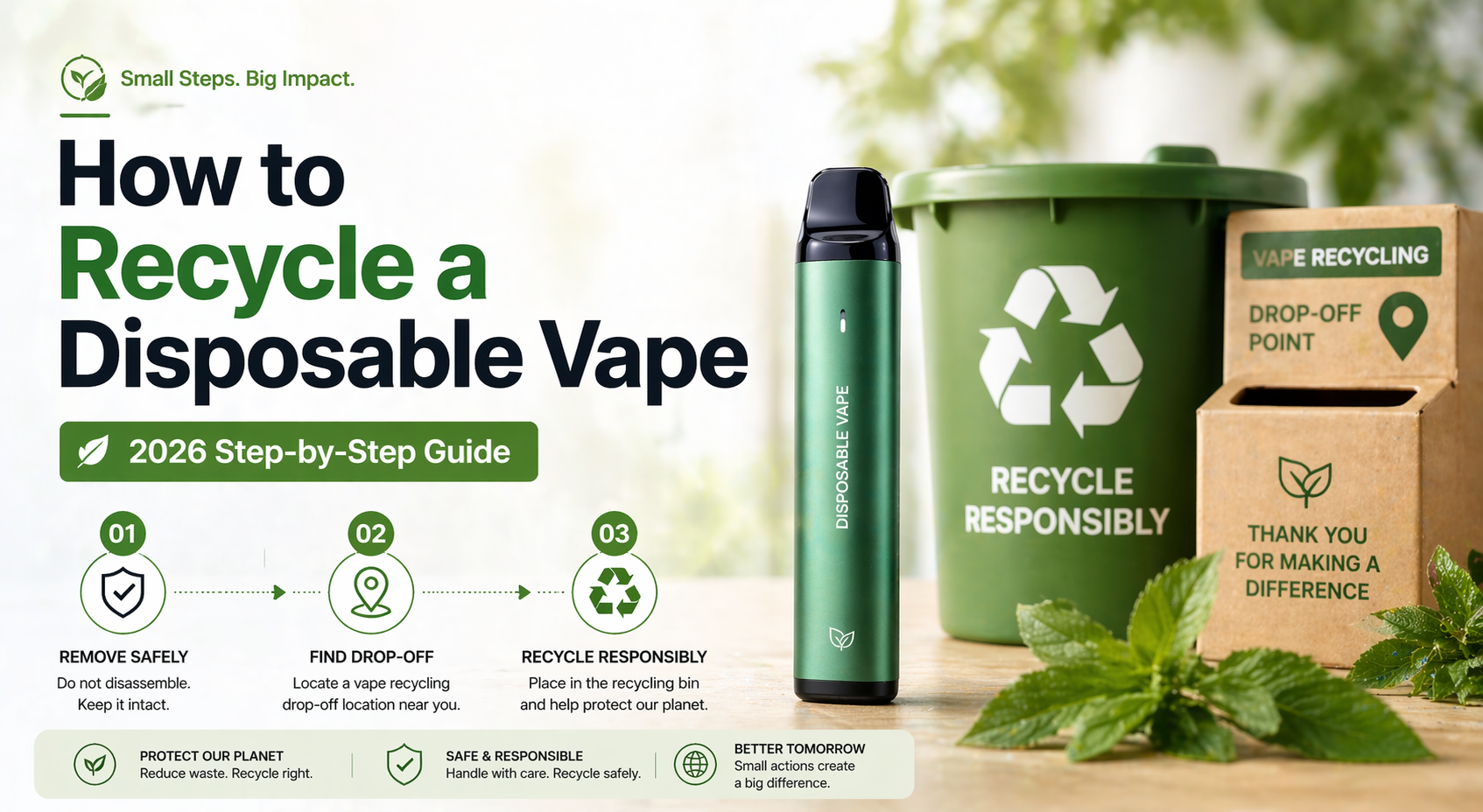
A used disposable vape is not regular trash. Under EPA rules, it's classified as hazardous waste — the device contains a lithium-ion battery that can ignite when compacted, plus residual nicotine that's toxic if it leaks into soil or water. Throwing one in a household bin risks a fire in the garbage truck, a fire at the recycling facility, and a fine in some states. This guide walks you through the 5-step safe prep process, the five legitimate places you can drop them off, Texas-specific locations for JellyPuffs customers, and what absolutely must never go in your regular trash. Written from our perspective as a Texas-based disposable vape retailer.
Why You Cannot Throw a Disposable Vape in the Trash
Under the Resource Conservation and Recovery Act (RCRA), the EPA classifies disposable vapes as hazardous waste for two reasons:
- Lithium-ion battery risk. When a garbage truck's compactor crushes a vape, the battery can short, ignite, and set the entire load on fire. Fires in recycling and waste facilities caused by discarded lithium batteries have risen sharply since 2020 and continue to climb as more disposables hit the market.
- Nicotine toxicity. The EPA lists nicotine e-liquid as acute hazardous waste code P075. It's toxic if absorbed through skin, poisonous to fish and aquatic life, and can contaminate soil if it leaks in a landfill.
Texas law doesn't specifically ban tossing a single vape in the trash, but Take Care of Texas — the state's consumer resource on the topic — explicitly states that rechargeable batteries and battery-equipped products should never go in household trash or curbside recycling. Any modern 15K+ puff disposable has a rechargeable lithium-ion battery. That means it goes to a designated recycler.
What's Inside That Makes It Hazardous
A typical 25K–50K-class disposable vape contains:
- A 280–1200 mAh lithium-ion battery — the biggest fire risk, holds meaningful energy even when "dead"
- Residual nicotine e-liquid — typically 15–20 mL of 5% salt nic, which is ~750–1000 mg of nicotine even when the device won't fire anymore
- A stainless steel or kanthal mesh coil contaminated with nicotine residue
- Internal wiring, solder, and a control chip
- Plastic casing (often recyclable separately in theory, but not practically extractable)
Of these, the battery is the only component that consumer recycling infrastructure actually processes efficiently. The plastic shell and coil travel to the battery recycler with the device, are separated at the facility, and the hazardous components are neutralized properly. That's why the device goes in whole — don't try to disassemble it at home.
Do not try to take your vape apart at home. Puncturing the battery casing can trigger a thermal runaway fire. Handling the raw battery exposes your skin to nicotine residue. And intact vapes are exactly what e-waste facilities are equipped to process — they do not need your help separating the components.
How to Prepare a Disposable Vape for Recycling
Before you drop off your used device, follow these five steps per EPA 2025–2026 guidance:
- Drain the battery fully. Keep puffing until the device stops firing completely. A fully discharged lithium cell has less energy to release if it gets damaged in transit. If the device has a charging port, don't recharge it at this stage.
- Tape the charging port and any exposed metal. Place a strip of electrical tape or non-conductive packing tape over the USB-C port and over any metal contacts. This prevents short circuits if the device rubs against another battery in storage.
- Seal the device in a clear plastic bag. A sandwich bag works. One vape per bag. This contains any nicotine residue and keeps the device separated from other items in your battery collection bin.
- Store in a cool, dry place until drop-off. Keep the bag away from direct sunlight, heat sources, and other batteries. A plastic container in a garage cabinet or closet shelf is fine. Collect multiple devices before making a trip rather than driving individually.
- Transport directly to an approved drop-off location. Do not leave vapes loose in a car on a hot day. Do not ship through standard USPS mail unless the program specifically provides a UN-certified lithium battery mailer (see Mail-Back section below).
Where to Take Your Disposable Vape — 5 Options
Five legitimate disposal channels exist for a used disposable vape. Ranked by accessibility for most U.S. customers:
| Option | How it works |
|---|---|
| 1. Call2Recycle drop-off locations | Nationwide network of 16,000+ drop-off points including Home Depot, Lowe's, Staples, and Batteries Plus Bulbs. Use the Call2Recycle locator at call2recycle.org to find the closest one. Most accept sealed, taped lithium-ion devices. Free. |
| 2. Batteries Plus Bulbs | Retail chain dedicated to battery recycling. Accepts lithium-ion batteries including fully-sealed disposables in most locations. Call ahead to confirm they accept whole vapes, not just raw batteries. Usually free for households. |
| 3. Municipal Household Hazardous Waste (HHW) facility | Every county in Texas and most U.S. municipalities run an HHW program. Some are permanent drop-off centers, others are quarterly collection events. In Houston, the Harris County HHW program and the City of Houston's recycling depositories both accept vapes. Free for residents. |
| 4. Independent vape shop take-back | Some local vape shops run take-back programs and consolidate used devices for proper recycling. Call ahead — not universal. Unlike retail drop-offs, these are usually the only option that accepts the whole device without requiring you to separate the battery. |
| 5. Manufacturer mail-back program | A small number of vape brands offer pre-paid mail-back envelopes for used devices. Not universal. Best option if you live far from any drop-off point. See the Mail-Back Programs section below for current programs. |
For most readers, Call2Recycle or Batteries Plus Bulbs will be the easiest route. Use the Earth911 database at earth911.com or call 1-800-RECYCLING to confirm a specific location accepts whole vape devices before you drive over.
Texas-Specific Drop-Off Locations
Since JellyPuffs ships from a Texas warehouse and many of our customers are Texas-based, here are known drop-off channels in the state. Verify hours and current acceptance policies before making the trip — facilities occasionally update their lists.
| Channel | Notes |
|---|---|
| Harris County HHW Program | Harris County Office of the County Engineer runs an HHW program accepting batteries, e-waste, and residual-nicotine products. Residents of Harris County (Houston metro) may use scheduled drop-off events. |
| City of Houston Westpark Consumer Recycling Center | A municipal recycling depository at 5900 Westpark Dr, Houston, TX 77057. Accepts batteries, e-waste, and household hazardous items from Houston residents. |
| North Main Neighborhood Depository | Second City of Houston recycling depository at 9003 N Main St, Houston, TX 77022. Same acceptance as Westpark. |
| Batteries Plus Bulbs — Houston metro | Multiple locations across the Houston metro, including a Champions location at 4765 FM 1960 Rd W Suite C, Houston, TX 77069. Accepts lithium-ion batteries. |
| Dallas / Fort Worth area | Most DFW suburbs run scheduled HHW collection events. Cities like McKinney offer curbside HHW/E-waste pickup by appointment, accepting lithium and rechargeable batteries in labeled containers. |
| Austin / Travis County | Austin Resource Recovery runs a permanent household hazardous waste facility. Accepts batteries, e-waste, and vape devices from Travis County residents. |
| San Antonio / Bexar County | City of San Antonio Solid Waste Management runs an HHW program with permanent drop-off options. Accepts lithium-ion batteries and e-waste. |
| Anywhere in Texas | Use the Call2Recycle locator at call2recycle.org for the closest drop-off point — typically a Home Depot, Lowe's, Staples, or independent battery shop within a few miles of most addresses. |
Mail-Back Programs — When to Use Them
If you live in a rural area without a convenient drop-off, mail-back programs are your fallback. They typically work like this: you buy or receive a pre-paid envelope with a UN-certified lithium-battery-safe liner, seal your used devices inside, and ship it to a designated recycler. Two important notes:
Never mail a loose vape through regular USPS or UPS without a certified mailer. Untreated lithium batteries are regulated hazardous material under 49 CFR 100–185, and shipping them without proper packaging is a violation of federal hazmat transport law.
Programs change frequently as new PMTA-authorized manufacturers launch and older ones close. Before committing to a mail-back, confirm the program is currently active and that the mailer meets UN specifications.
As of 2026, a few e-cigarette brands and third-party services offer mail-back, though none are universal. Check your specific vape brand's website for a "recycling" or "sustainability" page, or search for "vape mail-back recycling program" plus your brand name. Always verify the program ships pre-paid UN-certified packaging before you send anything.
What Must Never Go in Household Trash
Regardless of how convenient it feels, these items belong at a hazardous waste drop-off, never in your regular trash or curbside recycling bin:
- Any whole disposable vape, used or unused, expired or fresh
- Any lithium-ion battery, rechargeable battery, or battery pack — even when fully discharged
- Any vape with e-liquid still inside (nicotine contamination risk)
- Any visibly damaged, swollen, leaking, or punctured vape — these are acute fire risks and should go to HHW immediately in a sealed container
- Loose batteries removed from a device (short-circuit and fire risk)
- Vape cartridges, pods, or kits with residual e-liquid
- Charging cables bundled with the whole device (separate USB cables can go in normal e-waste)
Do not pour e-liquid down the drain — it's an EPA-regulated acute hazardous waste and contaminates water systems. Do not rinse out a vape to "clean" it for recycling — this spreads nicotine residue. Transport the sealed, taped, bagged device to a proper drop-off.
Frequently Asked Questions
Can I put a dead disposable vape in my curbside recycling bin?
No. Curbside recycling programs are not equipped to handle lithium-ion batteries, and a crushed battery in the recycling truck's compactor can start a fire. Even if the vape looks empty and feels inert, the battery retains enough energy to ignite under pressure.
Is it illegal to throw a disposable vape in the trash?
In several states — including California, New York, Washington, Colorado, and Illinois — yes, improper disposal of lithium-ion batteries and nicotine products violates state hazardous waste rules. In Texas, there's no explicit ban on a single-device household toss, but the state's Take Care of Texas program strongly discourages it. Commercial generators (vape shops, schools, offices) fall under federal RCRA rules regardless of state.
What happens if my vape is damaged or leaking?
A damaged, swollen, or leaking vape is an acute fire hazard. Place it in a sealed fire-resistant container (a metal can with a lid works, or a double-bagged zip-lock) filled with sand or vermiculite if available, keep it outside away from flammable materials, and contact your local HHW program for urgent drop-off guidance. Never ship a damaged battery.
Does JellyPuffs have a take-back program?
Not currently. JellyPuffs operates as an online retailer without a physical retail drop-off location. We're monitoring the rollout of the National Vape Recycling Program (NVRP) and similar initiatives expected in 2026 and beyond. For now, we direct customers to Call2Recycle, Batteries Plus Bulbs, and their local Household Hazardous Waste program.
How many disposable vapes should I collect before making a drop-off trip?
For most HHW programs, 5 to 20 devices is a reasonable batch. Many Texas county programs cap per-appointment quantities at around 20 vape devices. Collect over a month or two in a sealed plastic container, then make a single trip rather than driving for every empty device.
Can I recycle vape pods, kits, and charging cables separately?
Used vape pods with residual e-liquid follow the same hazardous waste route as disposables. Loose Type-C charging cables with no attached device can go in regular e-waste streams (many Best Buy locations accept them). Modular vape battery docks (Foger Switch Pro, Off-Stamp X-Cube) are the reusable component of the system — keep using them rather than recycling, which is why they're designed that way.
Is high-puff-count disposable more eco-friendly than buying smaller ones?
Per puff, yes. A single 50,000-puff device produces one unit of e-waste for roughly 33x the puffs of a 1,500-puff device. That's why high-capacity disposables have become the dominant category — fewer devices, fewer batteries, less overall waste. Modular systems with reusable batteries (Foger Switch Pro, Off-Stamp X-Cube) go a step further by replacing only the pod rather than the whole unit.
Shop Authentic Disposables
Shop authentic disposable vapes at JellyPuffs — every device is 100% authentic, sourced from verified U.S. distributors, and ships in discreet packaging from our Texas warehouse within 12 hours. When you're done with your device, recycle it properly using the steps above.
For more on disposable vape maintenance and troubleshooting, see how long a disposable vape actually lasts, why your disposable might not be hitting, or our companion guides on flying with a disposable vape and whether your vape sets off metal detectors.
Sources
- U.S. EPA — How to Safely Dispose of E-Cigarettes (consumer guidance)
- U.S. EPA — RCRA hazardous waste codes P075 (nicotine) and D001/D003 (lithium batteries)
- Call2Recycle — Drop-off location locator (16,000+ sites nationwide)
- Take Care of Texas — Rechargeable battery disposal guidance for Texas residents
- Harris County Office of the County Engineer — Household Hazardous Waste program
- City of Houston Solid Waste Management — Battery disposal guidance
- OCRRA — Model vape recycling program (Onondaga County, NY) as reference


