
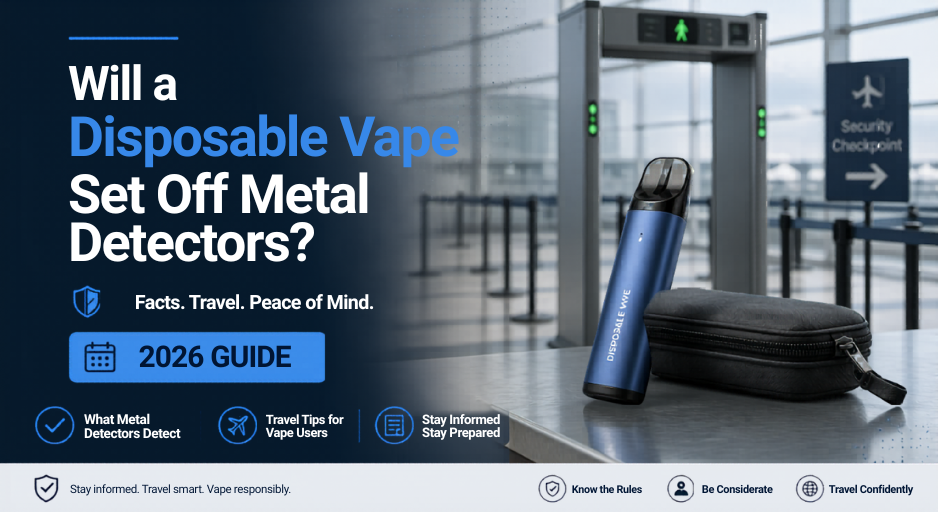
Short answer: most of the time, yes — but it depends on the venue. A modern disposable vape packs between 9 and 12 grams of metal between its lithium-ion battery, heating coil, wiring, and USB-C port, which is enough to register on any security scanner running at airport-grade sensitivity. Whether a specific checkpoint actually beeps depends on three things: the detector's sensitivity setting, the size of your device, and where on your body you're carrying it. Below is a venue-by-venue breakdown, what the alarm is actually picking up on, and what to do when your vape gets flagged. For a dedicated travel-focused breakdown, see our companion 2026 TSA rules guide for disposable vapes.
The 30-Second Answer
Airports & federal courthouses: Almost always detected. Declare it and put it in the bin.
Schools with wand scanners: Detected on purpose — the wands are marketed to schools specifically for catching vape pens.
NFL, NBA, and major concert arenas: Usually detected on modern multi-zone units, especially a 25K or 50K device.
Small venues, older magnetometers, shopping malls: Often pass without a beep, since these units are calibrated for firearms rather than small electronics.
What's Inside a Disposable That Triggers the Alarm
A modern high-puff disposable looks like a plastic brick, but the inner stack is dense with metal. A typical 25K to 50K-class device contains:
- A 280–1200 mAh lithium-ion battery (lithium, cobalt, nickel, aluminum casing)
- A stainless steel or kanthal mesh coil as the heating element
- Internal wiring, solder joints, and a control chip
- A USB-C charging port with metal contacts and shielding
- On some devices (Foger Switch Pro, Off-Stamp X-Cube), a metal inner chassis or magnetic pod sleeve
Total metal mass on a compact disposable typically lands in the 9-to-12 gram range — roughly the mass of two U.S. quarter coins stacked together. Bigger devices with 1000 mAh+ batteries and larger pods push that number higher, which is why an Artery CT3 Clearo 45K or a Foger Switch Pro 30K registers more strongly than a slim 15K Geek Bar Pulse.
How Metal Detectors Actually Work
Both walk-through gates and hand-held wands use pulse induction. The unit emits a brief electromagnetic pulse, and any metal object in the field generates an opposing magnetic field that the sensor picks up. The detector doesn't "see" shape — it measures how much the field is disturbed, then compares that against a sensitivity threshold that security staff configure for the venue.
Three variables decide whether your vape trips the alarm:
- Sensitivity setting. Airports and federal buildings run high. Malls and small concert venues run low.
- Metal mass. A slim 15K device has less metal than a 50K with a 1000 mAh battery.
- Placement. A vape in a front hip pocket passes through the detector's most sensitive coil zone. The same device in a backpack typically routes through x-ray instead.
Modern airports layer three technologies: walk-through metal detectors, Advanced Imaging Technology (AIT) millimeter-wave scanners that detect mass rather than metal, and 3D Computed Tomography (CT) scanners for carry-on bags that give a 360-degree view of every item. A vape shows up on all three — the question is just how quickly it's identified.
Venue-by-Venue Detection Guide
Detection probability varies dramatically by venue class. The table below summarizes the field for a standard 25K-class disposable carried in a front pocket:
| Venue | Detection probability & notes |
|---|---|
| Airport (TSA checkpoint) | Very high. Walk-through gate, x-ray, and often CT scanner all stack. Vapes must go in carry-on per TSA policy — declare and place in the bin. |
| Federal courthouse or government building | Very high. Sensitivity matches airport gates. Many federal facilities also ban vapes inside the building outright — check posted signage before the line. |
| School with wand scanner | High, by design. Purpose-built wands like the Garrett Super Scanner V are marketed to schools specifically to catch vape pens and their metal coils. |
| NFL / NBA / major arena | Moderate to high. Most venues upgraded to multi-zone AIT-style gates after 2023. A 50K device in a hip pocket typically flags; a 15K slim device sometimes slips through. |
| Concert or festival | Variable. Older magnetometers may miss a slim disposable; newer upgraded units catch most devices. Calibration changes week to week by event size. |
| Shopping mall, club, small event | Low. Basic magnetometers are tuned for firearms and often skip over small electronics entirely. |
These are general patterns, not absolutes. A specific checkpoint's calibration on a specific day can vary — a concert venue may run standard sensitivity for a small show and dial it up for a high-profile event.
What Makes Some Vapes Trigger More Than Others
Not every disposable behaves the same at a checkpoint. Three factors shift the odds:
Device size and battery capacity. A compact 15K-puff disposable carries noticeably less metal than a 50K device with a 1000 mAh battery and a bigger coil. The physical mass of metal inside is what the detector actually measures. Lean devices from Geek Bar and Lost Mary at the 15K tier are smaller than premium 50K bricks like the iJoy XP50000 or Artery CT3 Clearo 45K.
Chassis construction. Devices with a metal inner chassis or detachable-battery dock (Foger Switch Pro, Off-Stamp X-Cube) register more strongly than all-plastic-shell slim devices. The coil alone is enough to trigger a sensitive wand, but a metal sleeve amplifies the signature.
How you're carrying it. A vape in a front hip pocket passes directly through the detector's most sensitive coil zone at waist height. The same device in a jacket breast pocket or a backpack that goes through x-ray is a different story — x-ray will still see it clearly, but the walk-through gate may not beep.
One thing that won't save you: there is no commercially available "metal-free" disposable vape on the U.S. market. Every device has a battery and a coil, and the coil by itself is enough metal to register on any purpose-built wand.
What to Do If Your Vape Triggers the Alarm
At an airport, the playbook is straightforward:
- Before you reach the gate, take your vape out of your pocket and place it in a bin alongside your phone and keys.
- If security asks, answer honestly: "That's a disposable vape with a built-in lithium battery."
- Never check it at the gate. Lithium-ion batteries are banned in checked luggage by FAA rules because of fire risk in the cargo hold.
- Keep it in carry-on through the flight. Do not use it in the terminal or on the plane.
At a stadium or concert, check the venue's bag and electronics policy before you go. Most major U.S. arenas allow disposable vapes inside a clear bag but prohibit vaping in the seating bowl.
At a courthouse or federal building, assume vapes are banned inside and leave yours in the car. The downside of missing a puff for an hour is nothing compared to the downside of a federal security confrontation.
Common Myths, Debunked
Myth 1: "My vape is mostly plastic, so it won't beep."
False. The battery and coil alone are enough metal to trigger any sensitive detector. A plastic shell does not block an electromagnetic field.
Myth 2: "Aluminum doesn't register on metal detectors."
False. Pulse-induction detectors pick up both ferrous and non-ferrous metals, including aluminum, copper, and stainless steel.
Myth 3: "Wrapping it in foil will hide it."
False, and counterproductive. Foil is itself a solid metal mass and will trip the detector, while also concealing something suspicious — the worst possible outcome at any checkpoint.
Myth 4: "If the battery is dead, it won't detect."
False. Metal detectors respond to the physical presence of metal, not to whether a battery is powered. A dead vape registers the same as a full one.
Myth 5: "A zero-nicotine vape won't set it off."
False. The battery, coil, and wiring are identical between nicotine and zero-nicotine versions of the same device. Nicotine content has zero impact on metal detection.
Frequently Asked Questions
Will TSA confiscate my disposable vape?
No, as long as it's in carry-on and under the battery limits: 100 watt-hours for lithium-ion batteries, 2 grams lithium content for lithium-metal batteries. TSA allows disposable vapes in carry-on baggage. They only confiscate if the device exceeds those limits or you try to check it in a gate-checked bag.
Can I put my disposable in checked luggage?
No. The FAA and every major U.S. airline prohibit lithium-ion batteries in checked baggage because of fire risk in the cargo hold. Disposable vapes must travel in carry-on only, and they cannot be used or charged in the terminal or on the plane.
Will a school metal detector find a vape?
Yes, especially if the school uses a Garrett Super Scanner V or a similar high-sensitivity wand. These products are marketed to schools specifically for catching small metal items like vape pens — their sensitivity threshold is dialed below the metal mass of a typical disposable coil.
Do stadium metal detectors pick up vapes?
Most major NFL and NBA arenas upgraded to multi-zone AIT-style gates after 2023. A standard 50K disposable in a hip pocket typically registers. Smaller venues running older single-coil magnetometers may miss a slim 15K device, but most 2026 professional venues will catch it.
Does the vape have to be powered on for a detector to beep?
No. Metal detectors respond to the physical presence of metal, not to whether a battery is electrically active. A dead, brand-new sealed, or fully discharged vape registers the same as a working one.
Will a zero-nicotine disposable trigger a detector?
Yes. Nicotine content has no effect on metal detection. The battery, coil, wiring, and chassis are identical between nicotine and zero-nicotine versions of the same device.
Can I take a disposable vape into a federal courthouse?
Usually no. Most federal courthouses prohibit electronic smoking devices inside the building regardless of whether they're powered. Check posted signage before the security line and leave the vape in your vehicle if you're unsure.
Where to Buy Authentic Disposables
Shop authentic disposable vapes at JellyPuffs — every device is traceable by QR code, ships in clean discreet packaging from our Texas warehouse, and goes out within 12 hours of ordering.
If you're flying, heading to court, or going through any other metal-detector checkpoint, the most reliable rule is the simplest one: assume the detector will see it, and plan around the venue's actual rules rather than around trying to beat the machine. For more on flying with your disposable, see our 2026 TSA rules guide, or check how long your disposable actually lasts if you're timing a device swap around a trip.
Sources
- TSA — Electronic Cigarettes and Vaping Devices (carry-on rules, battery limits)
- MetalDetector.com — Garrett Super Scanner V for detecting vape pens in schools
- Mood — Metal mass and sensitivity framework for vape detection
- Vapesourcing — 2026 travel guide: vapes and metal detectors
- Hometown Hero — Pulse induction technology and airport screening
- Elyxr — Disposable vape metal components and venue detection variables
- BallistiSCAN — Walk-through detector marketed with vape-detection use case


